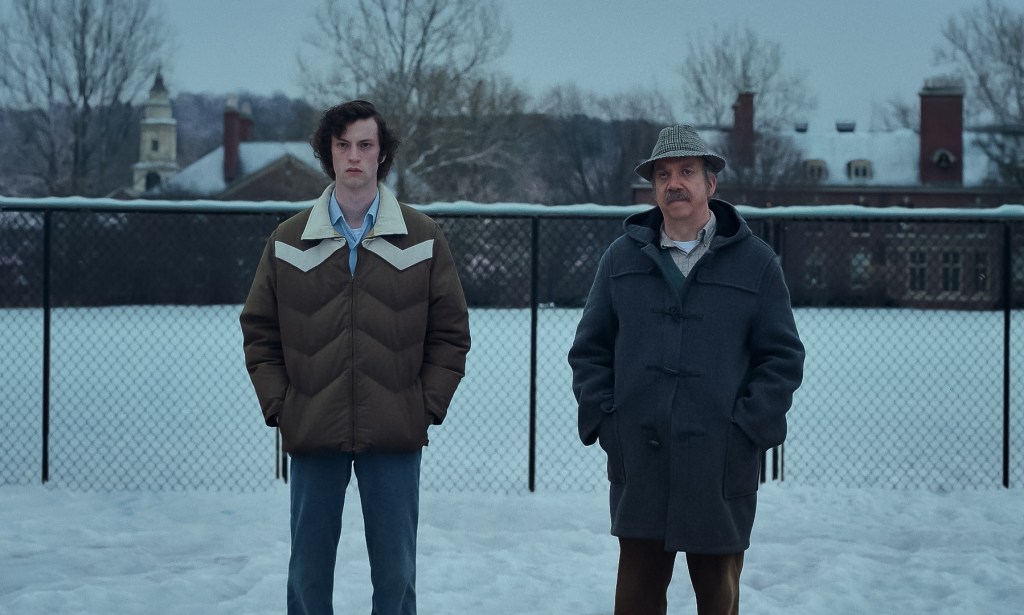
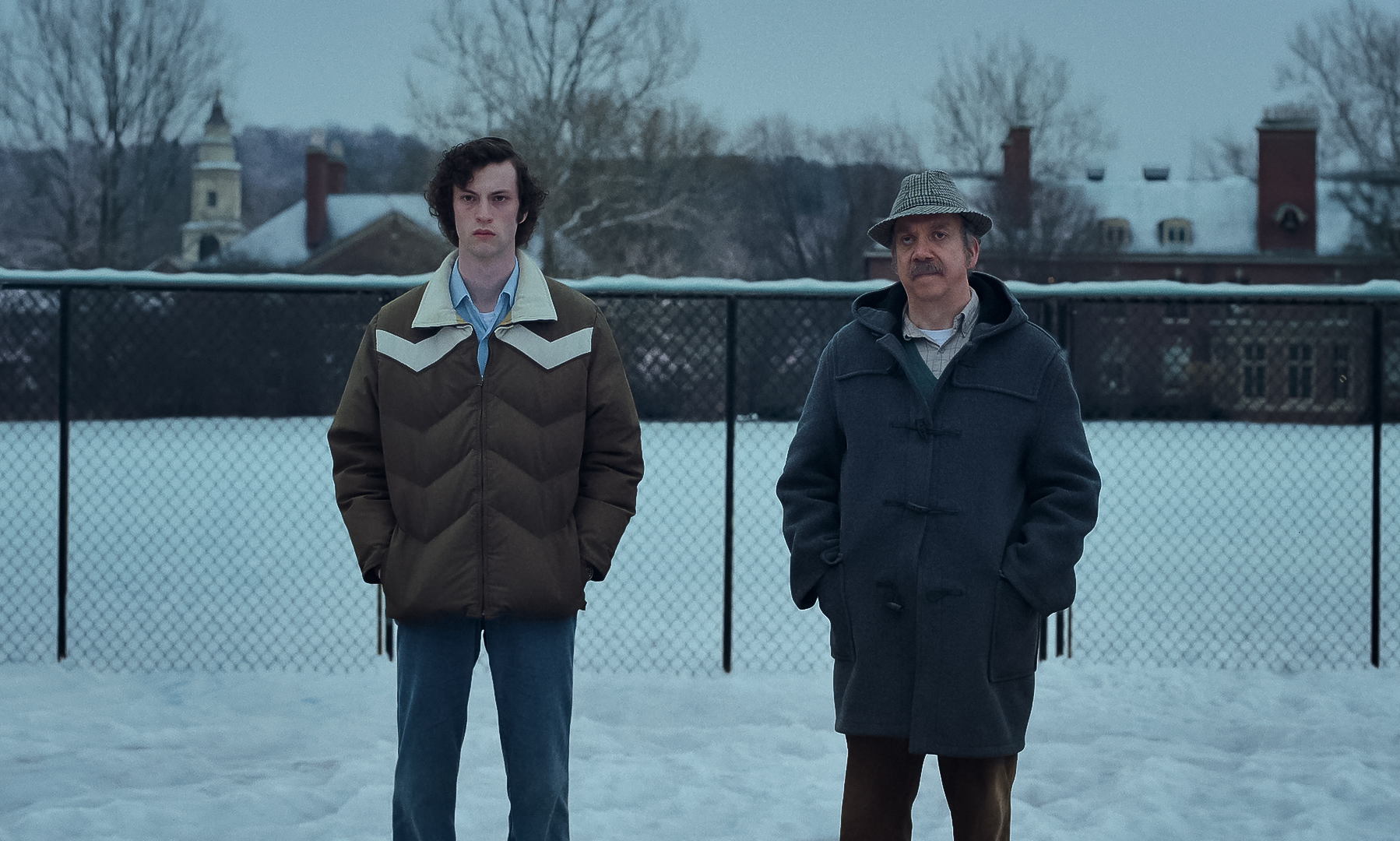
The Holdovers is the eighth major picture from writer/director Alexander Payne (Sideways, Election), starring Paul Giamatti, Da’Vine Joy Randolph, and newcomer Dominic Sessa. The film takes place in the 1970s at a prep school over the holidays. Giamatti plays a history teacher named Paul Hunham, who is the very definition of a crank, who gets stuck having to stay over the winter break to watch a handful of kids who have nowhere to go. The majority of the holdover kids end up, quite literally, getting helicopter evaced by one of the parents to go on a ski trip, leaving the majority of the film with just Hunham, the school’s Head Cook Mary Lamb (Randolph), and a lone student, Angus Tully (Sessa).
In The Holdovers each of its main three characters is teetering on the brink of a personal crisis. Hunham, who is widely known to be hated by both the students and faculty, is on thin ice with the school’s president after failing a senator’s kid, despite being told not to. Mary Lamb is in mourning after her only son, Curtis, has passed away in the Vietnam War. She stays over the break because it is the last place she got to spend time with her son. She got the job as a cook as a way to be able get her kid into the prep school. The reason Angus is holding over is because his mother had decided to go on honeymoon with her new husband, reneging on a promise to take her son with them on a trip to St Kitts. You can tell there is tension within the family structure, but the full scope isn’t revealed until later in the film.
In a lot of ways this is a quintessential Payne film. The main characters all share a sort of world weary disposition. The Giamatti performance in particular just drips with irony and pure disgust for a world that seems unjust, and is only getting a little dumber by the day. Hunham spends the entire film just hammering his students, peers, and even superiors with one liners so sharp they often fly right over the heads of their targets. There’s a great line Hunham gives while he’s at a Christmas party, trying to flirt with someone who is clearly not interested in him, in which the teacher divvies out his entire worldview. “The World doesn’t make sense anymore,” Hunham tells Carrie Preston, a coworker Hunham clearly has feelings for. “It’s on fire. The rich don’t give a shit, poor kids are cannon fodder, integrity’s a punchline. Trust is just a name on a bank.”
:max_bytes(150000):strip_icc():focal(745x126:747x128):format(webp)/paul-giamatti-in-n-out-burger-tout-010824-978ffccac1a24da49698ae5079b18325.jpg)
This film shows Giamatti in peak form. It’s no wonder he’s already taken home a Golden Globe, and is nominated for a slew of other awards. Much like his performance in Sideways, Giamatti is able to completely inhabit the world Payne is creating around him; he has said in interviews that this character came to him so naturally that it often felt like he wasn’t working hard enough. Both of Giamatti’s parents are academics. As great as Giamatti is at playing dumb characters, I feel like his performances are elevated almost exponentially when he’s allowed to play the smartest person in the room. I’m not sure if there are more than a handful of people on this planet who can go toe-to-toe with him in a scene where he’s given a great script to work off of.
Here’s the thing though, as much as I loved Giamatti in The Holdovers, I feel like Randolph and Sessa kind of steal the show. The critical consensus seems to be that Randolph is basically a lock to win Best Supporting Actress at the Oscars, and I can’t argue. She gives the film the much needed injection of warmth and humanity that keeps it from turning overly acidic. She’s the only character that seems to be able to cut through Hunham’s bullshit, often with just a single line. It’s one of the most believable performances of a mothers grief I’ve ever seen, but there’s a deep current of strength and resolve that inspires hope. Rudolph is the heart and soul of the film, and I expect her to be in high demand in Hollywood going forward.
Perhaps the most surprising performance in the film is given by Sessa as the young Mr Tully. These kinds of stories, featuring the cantankerous old teacher and his precocious, rough around the edges pupil have been told from time immemorial. For the movie to work Sessa had to bring something new to the role. Sessa actually auditioned for the character at the same school that they ended up filming the movie from. It’s his first time acting in anything outside of his high school theater group. Perhaps this is why he is able to give a performance so believable; both in the fact that his body is so gangly and awkward that you can’t help but only imagine this guy as a kind of dorky high school kid, and the sheer rawness of his performance. Everything from the constant nervous energy, to the wide-eyed realization that the world is just too much for a person to bear, he’s such a perfect foil to Giamatti who is always in full command of his performance. I think it was a brilliant piece of casting from Payne, and a star-making performance for Sessa, who really is mesmerizing.
All three of the film’s lead actors are so incredibly emotive, not just in their line reading, but also the pain and frustration expressed in the tiniest of facial expressions. One of Payne’s greatest gifts is his ability to frame his actors, capturing untold depths with a close-up shot. He knows when to let the camera linger a few beats more than other directors would. There’s a scene late in the movie when Hunham is trying to reassure Tulley, who is afraid that he is going to suffer the same ills that befell his father. The camera pulls super tight on Giamatti and Sessa. In Sessa’s face you can see a kid about to completely crumble, suffering from a crisis of the soul, and the reverse shot of Giamatti, with those hangdog eyes glowing and resolute, trying to rescue his pupil. It’s an incredible scene that is just two actors at a table baring their souls and a director who knows exactly how to capture it for maximum effect.
I’ve read criticism of The Holdovers that its ambitions as a film are a little slight. I think we’ve been desensitized to smaller stories on film because we just don’t see them a lot anymore. Most films that get made, let alone are talked about these days, feature superheroes trying to literally save the universe, or “great men” dealing with the repercussions of building an atom bomb, or a movie that is trying to simultaneously grapple with big ideas like commercialism and modern feminism using the biggest toy IP in history. While the Marvel Cinematic Universe may finally be loosening its clutches on the film industry, what came in its wake still feels superhero adjacent. I loved Oppenheimer, but there is literally a scene where someone tells Oppie to “suit up.” It looked like something straight out of a Batman film. For as delightful as I found Barbie, that entire IP is about suiting up and living in a fantasy world. I hope Oppenheimer and Barbie, two movies made by brilliant auteurs, but still exist in the tentpole paradigm of modern Hollywood, are cinematic methadone. I want – crave really – to see more movies like The Holdovers, films where the interior lives of its characters burn with the same intensity as a hydrogen bomb.
 Justin Jacobs
Leave a comment